
Solar Outdoor Wall Lights Range Guide for Distributors
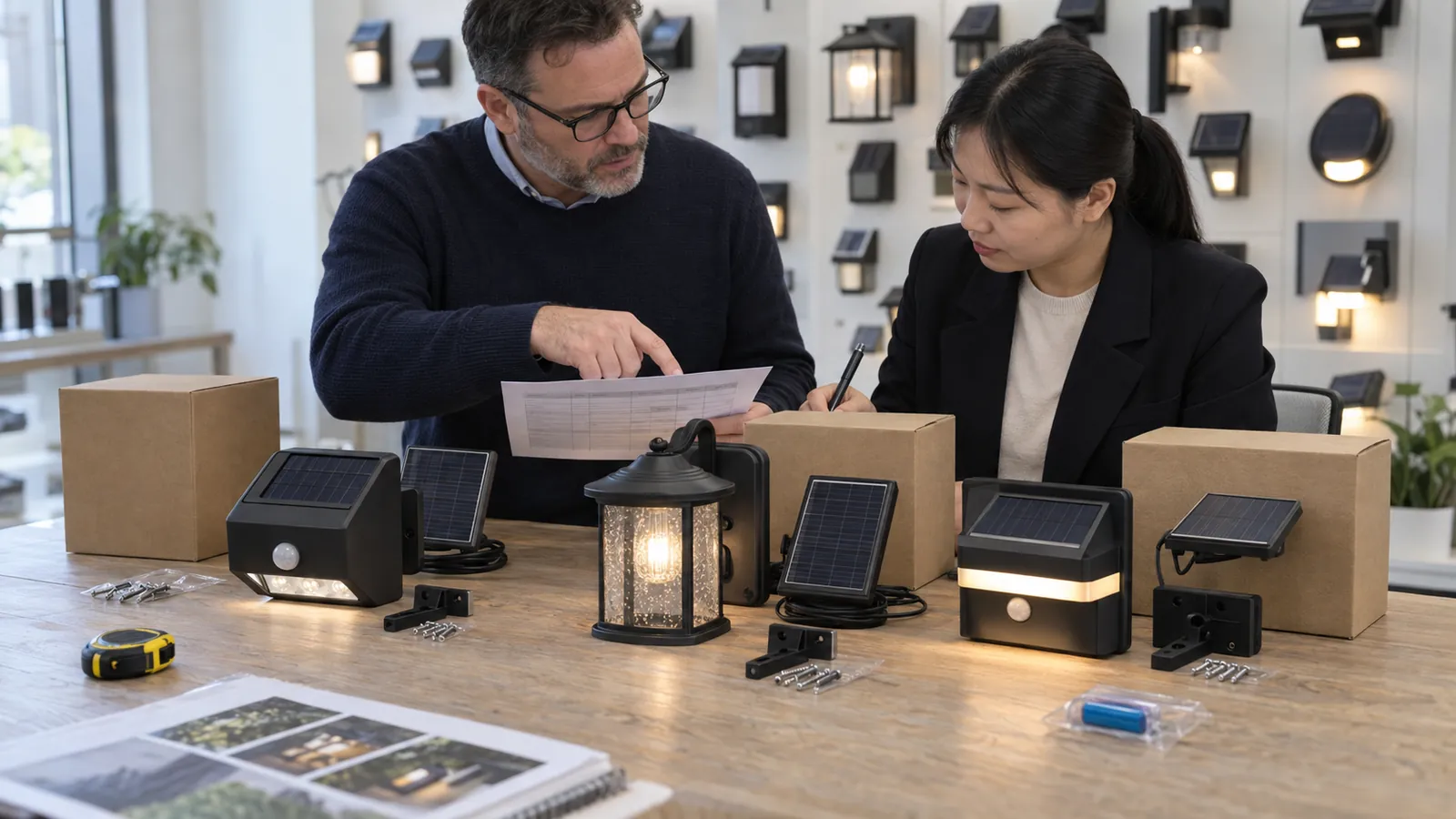
Table of Contents
- Start With the Sales Channel Before Choosing Solar Wall Light SKUs
- Build an Entry-Level Range for Price-Sensitive Retail Channels
- Add Mid-Range Solar Wall Lights With Clear Functional Upgrades
- Use Premium SKUs to Create Margin and Brand Differentiation
- Compare Security, Decorative and Hybrid Solar Wall Light Categories
- Security Motion Sensor Solar Wall Lights
- Decorative Solar Wall Lights
- Hybrid Low-Light and Motion-Boost Models
- Separate Solar Panel Models
- Plan a First-Order SKU Mix Without Overextending Inventory
- Step 1: Select Three Core Use Cases
- Step 2: Assign One Opening Price Tier to Each Role
- Step 3: Limit Cosmetic Variants
- Step 5: Reserve Capacity for Learning
- Use a Product Range Matrix to Compare Features and Target Channels
- Remove Products That Compete for the Same Customer
- Questions to Ask a Solar Wall Light Supplier Before Sampling
- Product and System
- Construction and Outdoor Suitability
- Commercial and Supply
- Compliance and Shipping
- Approve the Range Architecture Before Approving Individual Samples
- FAQ
- How many solar outdoor wall light SKUs should a distributor launch first?
- Are more LEDs a useful way to compare models?
- When should a separate solar panel model be included?
- What information should be sent when requesting a product recommendation?
- Build the First Range Around Decisions You Can Verify
Distributors building a solar outdoor wall lights range should start with the sales channel and use case, then choose a small number of products with distinct jobs. A practical first range normally needs a security-led model, a decorative model and a hybrid model that provides low-level illumination with motion-triggered output. Each role can then be divided into entry, mid-range or premium tiers only where the channel supports the difference.
This guide is for importers, distributors, retail buyers and private-label product managers planning a category. It explains which product types belong together, where price tiers should differ, how to limit the first SKU count and what to verify before sampling. By the end, you can draft a range architecture and focused sampling brief.
For available models, begin with the [SconceHaus solar wall lights category](https://sconcehaus.com/wall-lamps/solar-wall-lights/). Use this guide to decide what should be in the range before requesting individual specifications.
Start With the Sales Channel Before Choosing Solar Wall Light SKUs
The same solar wall light can perform well in one channel and fail in another. A hardware distributor may need clear functional differences and repeatable stock. A garden retailer may emphasize finish and shelf presentation. An online seller needs differences visible in thumbnails. A project buyer may accept fewer designs but require tighter documentation.
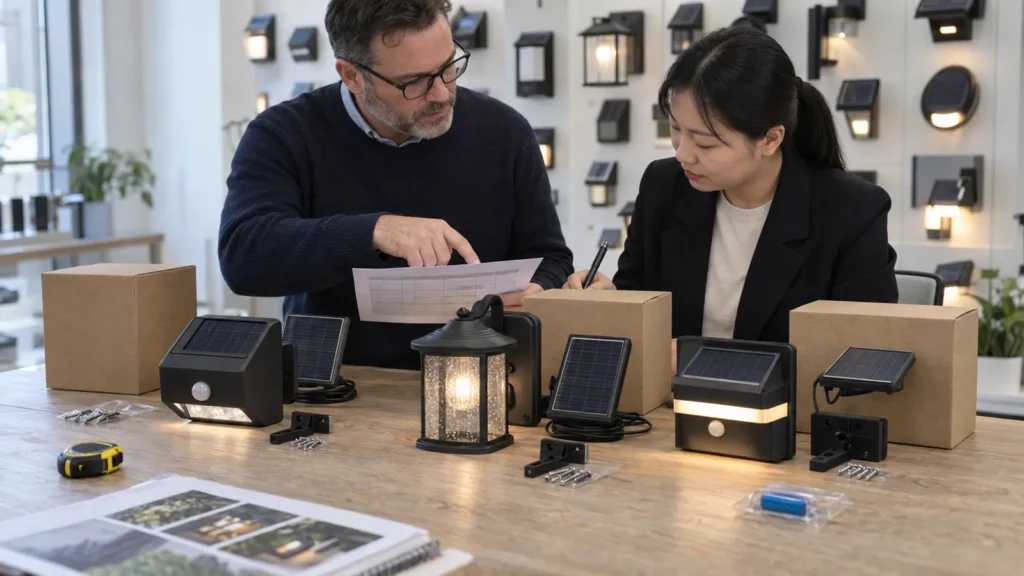
Define the primary channel before reviewing products:
| Channel | Buyer decision | Range implication | Common sourcing risk |
| Hardware and security retail | Does the product solve a visible entrance or perimeter problem? | Lead with motion-sensor models and simple function explanations | Too many modes that staff cannot explain |
| Home and garden retail | Does it improve the exterior while providing useful light? | Include decorative forms and warmer visual effects where supported | Security-style products dominate and weaken the décor offer |
| E-commerce | Can shoppers see a meaningful difference between listings? | Use distinct silhouettes, functions and applications | Near-duplicate SKUs compete for the same search and ad traffic |
| Electrical or lighting distribution | Can the distributor specify the product accurately? | Require structured data sheets, mounting information and document status | Marketing claims are not backed by model-specific files |
| Property or hospitality projects | Does the model fit the site, maintenance plan and approval process? | Use fewer models with controlled finishes and samples | Retail packaging and feature complexity add cost without project value |
Next, define the job each SKU must do. “Solar wall light” is too broad to be a useful purchasing brief. A better brief separates entrance security, pathway orientation, decorative façade lighting and mixed everyday/security use.
Ask four questions before opening a supplier catalog:
1. Which customer problem must this range solve first?
2. Which channels will carry inventory?
3. Which features will justify a step up in price?
4. How many visibly different choices can the sales team support?
This sequence prevents a common category-planning error: choosing attractive products first and trying to assign them roles later.
Build an Entry-Level Range for Price-Sensitive Retail Channels
An entry-level range should be easy to understand, easy to compare and economical to replenish. It should not be a stripped-down copy of a higher model with claims that cannot be verified.
The entry tier usually needs one clear promise. For example, it may be a compact motion-activated light for a gate or side entrance, or a simple decorative light for low-level orientation. The exact lumen output, runtime, detection range and IP rating must come from the model specification or test documents. Do not define the tier by LED count. LED quantity does not establish useful light output, system efficiency or runtime.
Prioritize:
- A simple operating mode that can be explained on packaging
- A mounting method suitable for the intended channel
- A housing and finish appropriate to the target environment
- An accessible on/off or mode control
- Clear battery and solar-panel identification
- Packaging that protects the lens, panel and mounting parts
- A complete accessory set and readable instructions
Avoid loading the entry tier with several visually similar models. If two products share the same use, similar housing, similar light pattern and the same price band, the second model may divide demand without adding coverage.
An entry SKU is appropriate when the customer values a straightforward function and the retailer needs a low-risk opening price. It is less suitable when the installation has limited solar exposure, the buyer requires documented high-output performance or the channel expects extensive certification records. Those requirements may require a different system design, documentation package or price tier.
Add Mid-Range Solar Wall Lights With Clear Functional Upgrades
The mid-range should earn its position through a feature customers can understand and buyers can verify. A cosmetic change alone rarely supports a durable price step.
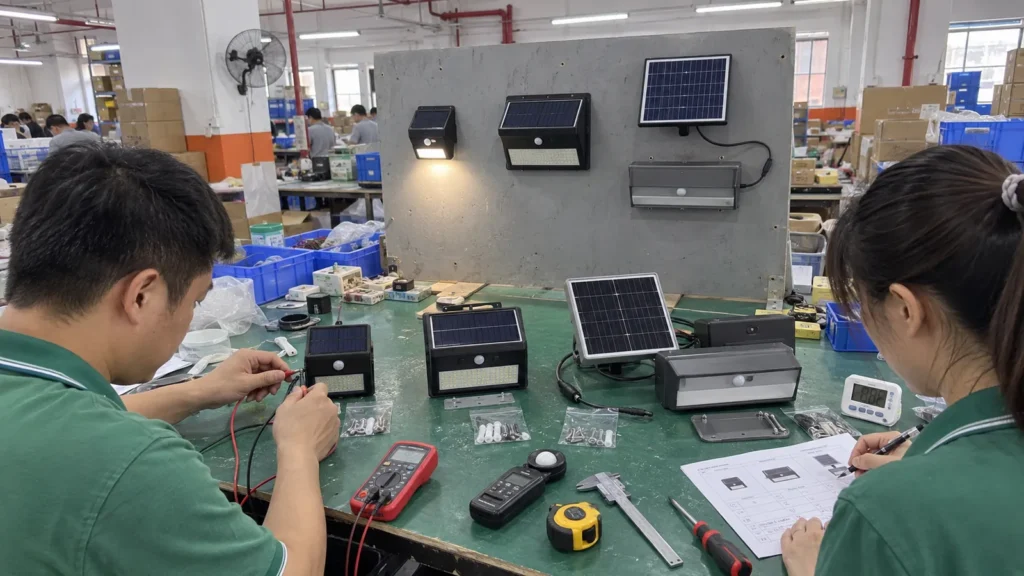
Useful mid-range upgrades may include:
- A larger or better-positioned solar panel
- A battery specification matched to the lighting mode
- More deliberate motion-sensor logic
- A choice between constant low light and motion-triggered high light
- Better control of beam direction
- More substantial mounting hardware
- A housing or coating selected for the intended outdoor environment
- Improved retail packaging or private-label presentation
These features interact. A higher-capacity battery does not fix an undersized solar panel. A large panel does not guarantee useful charging when the mounting position is shaded. Higher output changes the energy budget and may shorten runtime unless the panel, battery and operating logic are designed together.
This is why a mid-range quote should be reviewed as a system. The comparison should show the solar-panel rating, battery chemistry and rated capacity, lighting modes, measured or declared lumen output, sensor settings and test conditions behind any runtime claim. The next article in this cluster, [Solar Wall Light Specifications Wholesale Buyers Should Compare](https://sconcehaus.com/solar-wall-light-specifications-wholesale-buyers/), provides a specification-by-specification comparison sheet.
Use the mid-range for channels where customers will pay for a visible improvement in function, construction or presentation. Do not create a mid-tier by adding features that are difficult to explain, rarely used or unsupported by test data.
Use Premium SKUs to Create Margin and Brand Differentiation
A premium solar outdoor wall light should give the range a reason to exist beyond price. It may provide a more architectural appearance, a separate solar panel for placement flexibility, controlled up-and-down light, a more substantial material and finish system, or a configurable operating profile.
Premium does not mean adding the largest possible LED count, battery claim or number of modes. It means that the product addresses a use case the lower tiers cannot address as well.
Possible premium roles include:
- An architectural solar wall light for design-led retail
- A separate-panel model for mounting locations where the fixture and best solar exposure do not coincide
- A high-coverage security model for entrances or larger perimeter zones
- A coordinated family with multiple sizes or finishes
- A model developed for a private-label program with controlled components and packaging
Premium products need stronger evidence because the price comparison is less forgiving. Request product drawings, component specifications, photometric information where available, finish details, packaging configuration and model-specific test documents. If a supplier states that a product is UL or ETL certified, verify the manufacturer and model in the official [UL Product iQ database](https://www.ul.com/software/product-sourcing-and-certifications-database) or [Intertek ETL Listed Mark Directory](https://www.intertek.com/directories/etl-listed-mark/). A generic laboratory logo or report from a related model does not establish that the quoted model is certified.
Premium SKUs are suitable when the channel can communicate the difference and protect the price position. They are poor choices for an opening order if the distinction exists only in the supplier’s presentation and cannot be demonstrated in the sample.
Compare Security, Decorative and Hybrid Solar Wall Light Categories
The first range should cover different use cases, not repeat the same one in several housings.
Security Motion Sensor Solar Wall Lights
Security-led models prioritize detection, useful illumination and coverage. Buyers should compare detection logic, mounting height assumptions, delay time, output by mode and the relationship between the panel, battery and load.
Suitable channels include hardware, security, general merchandise and selected project applications. These models are less suitable for design-led ranges when the appearance is overtly technical or the beam creates unwanted glare near seating and hospitality areas.
Decorative Solar Wall Lights
Decorative models prioritize daytime appearance and a controlled nighttime effect. The finish, diffuser, visible light source and beam pattern matter as much as nominal output.
Suitable channels include home, garden, hospitality and design-led e-commerce. They are less suitable where the primary requirement is wide-area security illumination or long high-output operation.
Hybrid Low-Light and Motion-Boost Models
Hybrid models maintain low-level light and increase output when motion is detected. They can bridge orientation and security needs, but the energy budget must be reviewed carefully. The claimed runtime depends on charging conditions, mode settings and the number of motion events.
Suitable channels include residential outdoor, general hardware and multi-use retail. They are less suitable when the buyer needs a single, predictable operating profile or when the packaging cannot explain the mode logic clearly.
Separate Solar Panel Models
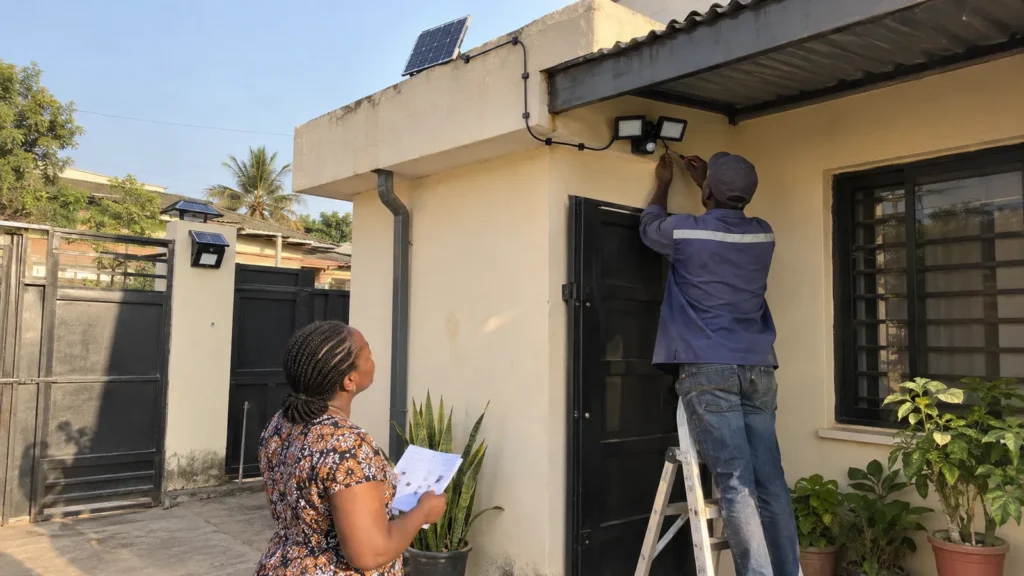
These models separate the luminaire from the panel using a cable. They can help when the light belongs under an eave or in shade while the panel can be placed in better sunlight. The cable length, connector sealing, panel mount and installation instructions become part of the product specification.
They may suit selected security and project applications. They add parts, packaging volume and installation steps, so they should not be included unless the placement flexibility solves a real channel need.
Plan a First-Order SKU Mix Without Overextending Inventory
There is no universal first-order SKU count. The correct number depends on channel coverage, available inventory budget, minimum order quantities, packaging versions and the buyer’s ability to replenish. The planning principle is more important than a fixed number: every SKU must have a distinct role.
A disciplined opening range can be built in five steps.
Step 1: Select Three Core Use Cases
Choose one security role, one decorative role and one hybrid or placement-flexibility role. If the business serves only one channel, two roles may be enough. Do not force a decorative product into a security-focused assortment simply to create variety.
Step 2: Assign One Opening Price Tier to Each Role
Start with the tier most likely to sell in that channel. Add a second tier only where the upgrade is visible and the forecast supports it.
Step 3: Limit Cosmetic Variants
Color and finish variants create separate inventory even when the product is technically identical. Begin with finishes already supported by channel data or customer demand. Avoid ordering several colors because they are available.
Step 4: Check Internal Competition
Place every proposed SKU on one sheet. Compare application, appearance, feature set and target price. If two rows are nearly identical, remove one or give it a clearly different role.
Step 5: Reserve Capacity for Learning
The first order should generate evidence for the next decision. Track sell-through, returns, customer questions, mode confusion, installation issues and finish preferences. Use those results to expand or remove SKUs.
Before fixing quantities, obtain the MOQ by model, MOQ by color, packaging MOQ, carton quantity, sample availability and replenishment lead time. A nominally flexible MOQ can still create excess inventory if each finish requires a separate production minimum.
Use a Product Range Matrix to Compare Features and Target Channels
Use this matrix to build the range brief. Replace “verify” with model-specific data only after reviewing the supplier’s specification and samples.
| Product type | Target channel | Recommended price tier | Core functions to define | Suitable for | Less suitable for |
| Compact motion-sensor security light | Hardware, security, entry e-commerce | Entry | Motion logic, output by mode, detection settings, mounting | Gates, side entrances, garages | Design-led hospitality or large coverage claims without data |
| Hybrid low-light/motion-boost light | Hardware, home, general retail | Mid | Standby output, triggered output, event assumptions, battery/panel match | Entrances, walkways, everyday residential use | Buyers needing one simple operating profile |
| Decorative solar sconce | Home, garden, hospitality, design e-commerce | Mid or premium | Finish, diffuser, beam effect, CCT, mounting | Porches, patios, decorative façades | Wide-area security applications |
| Up-and-down solar wall light | Lighting retail, architecture-led e-commerce | Premium | Beam pattern, surface effect, lumen data, finish | Feature walls and entrances | Customers buying only on maximum coverage |
| Separate-panel security light | Security, property, selected projects | Mid or premium | Panel rating, cable length, connector sealing, mounts | Shaded fixture locations with accessible sun | Simple retail where extra parts create confusion |
| Coordinated private-label family | Brand and multi-channel retail | Premium | Shared design language, controlled components, packaging | Brands building a recognizable range | Small tests where tooling or packaging minimums are not viable |
Link the matrix to model number, quotation date, MOQ, sample status, document status and packaging version so different revisions are not treated as one product.
Remove Products That Compete for the Same Customer
Internal competition is easy to miss because suppliers present each model separately. The buyer needs to compare the proposed range as a whole.
Consider removing one product when two SKUs have:
- The same primary application
- Similar output and mode logic
- Nearly identical silhouettes
- The same mounting method
- Overlapping price positions
- No meaningful packaging or channel distinction
Keep both only when the difference supports a clear choice, such as compact versus wide coverage, integrated versus separate panel, decorative versus security styling, or entry versus premium construction.
Standardize test conditions before ranking products. A model tested in continuous high mode is not directly comparable with one whose runtime assumes low mode and few sensor activations.
Questions to Ask a Solar Wall Light Supplier Before Sampling
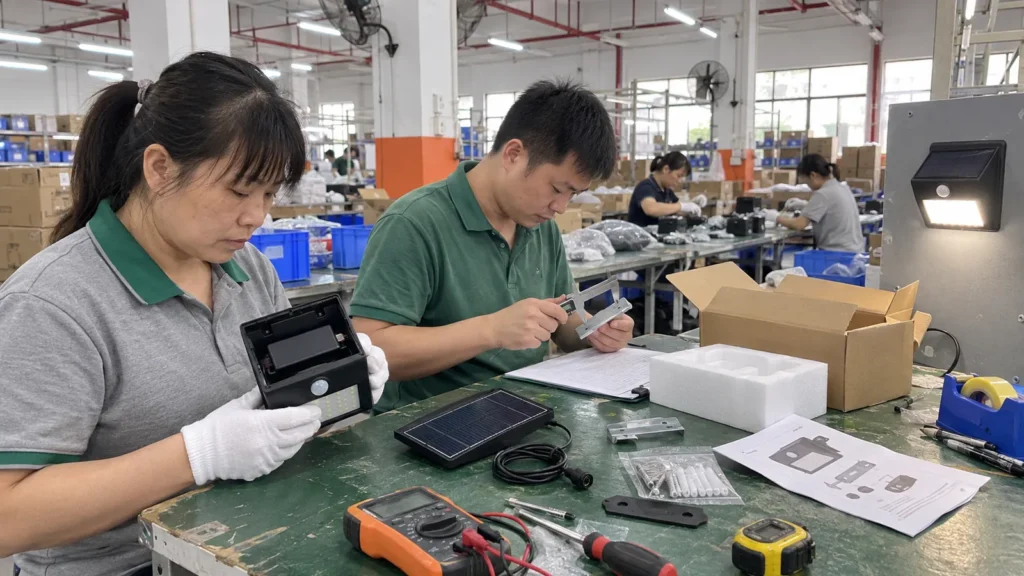
Send the same question set to every supplier:
Product and System
- What is the exact model number and revision?
- What are the intended application and mounting conditions?
- What are the solar-panel type, rated power and dimensions?
- What are the battery chemistry, nominal voltage, rated capacity and replaceability?
- What are the declared lumen output and lighting modes?
- Under what conditions was runtime measured?
- What are the PIR detection range, angle, delay and mode logic?
- What mounting hardware and accessories are included?
Construction and Outdoor Suitability
- What are the housing, lens, gasket and fastener materials?
- What coating or finish is used?
- What IP rating is claimed for the complete product?
- Can the supplier provide the report supporting that model and construction?
- Are coastal, high-temperature or other severe environments part of the design brief, or must they be evaluated separately?
The IP code classifies enclosure protection under [IEC 60529](https://webstore.iec.ch/en/publication/2452). An IP claim should be tied to the complete tested construction. It should not be inferred from a sealed-looking housing or an informal water spray.
Commercial and Supply
- What are the sample cost, preparation time and MOQ by model, finish and packaging version?
- Which components are controlled, and what is the change-approval process?
- What are the carton details, private-label options and after-sales remedies?
Compliance and Shipping
- Which certifications or reports apply to the exact model?
- Who is the certificate holder?
- Can the listing be verified in the issuing body’s directory?
- Is a current UN 38.3 test summary available for the lithium battery used in the product?
- Which battery and transport documents will accompany samples and production shipments?
The UN Manual of Tests and Criteria contains the lithium battery provisions in subsection 38.3; buyers should review the current [UNECE edition and amendments](https://unece.org/transport/standards/transport/dangerous-goods/un-manual-tests-and-criteria-rev8-2023) with their carrier or compliance adviser.
Approve the Range Architecture Before Approving Individual Samples
Sampling should confirm a defined purchasing decision. Before requesting units, approve each SKU’s role, channel, tier, required documents, finish, packaging and test plan. Then use the [solar wall light sample approval scorecard](https://sconcehaus.com/compare-solar-wall-light-samples/) under documented conditions.
FAQ
How many solar outdoor wall light SKUs should a distributor launch first?
There is no universal number. Start with the fewest SKUs that cover the required use cases and price positions. Every SKU should have a distinct role. Add variants after sell-through, returns and customer feedback show where the range needs more coverage.
Are more LEDs a useful way to compare models?
No. LED count does not establish total light output, beam distribution, system efficiency or runtime. Compare measured or declared lumens, optical distribution, operating mode and the complete energy system.
When should a separate solar panel model be included?
Include it when the fixture location may be shaded but the panel can be mounted in better sunlight. Confirm cable length, connector sealing, panel mounting and packaging before sampling.
What information should be sent when requesting a product recommendation?
Send the destination market, sales channel, planned price tiers, expected first-order quantity, required certifications and reference images. SconceHaus can then recommend a focused sample plan rather than an unfocused catalog. Submit your sourcing requirementsto begin.
Build the First Range Around Decisions You Can Verify
A useful solar outdoor wall lights range gives each SKU a specific customer, application and price role. Add tiers only when the upgrade can be explained and verified, and keep the first order narrow enough to learn from sell-through and returns.
For a product recommendation or sample plan, send SconceHaus your target market, sales channel, expected first-order quantity, required certifications and reference images through the project enquiry page.

SconceHaus
The SconceHaus team shares practical wall-light sourcing, specification and project insights for professional buyers.
Wall Lights for Your Next Project
Compare specifications and add suitable models to one consolidated quote request.
Related Lighting Insights
Sep 23, 2026
Commercial Wall Sconce Submittal Checklist for Project Buyers
Use a commercial wall sconce submittal checklist to control drawings, document gaps, approvals, revisions, and quote go/no-go decisions.
Sep 20, 2026
Outdoor Motion Sensor Wall Lights: A Buyer’s Guide to Control Modes and Channel Positioning
Use a mode evidence sheet to compare outdoor motion sensor wall-light control logic, approve channel claims, and close…
Sep 3, 2026
The Complete Guide to Choosing Wall Sconces & Planning the Electrical Rough-In
Learn how to choose wall sconces and plan electrical rough-in details, including CRI, color temperature, glare control, junction…
Working With SconceHaus
Common questions about samples, customization, quality, production and delivery.
Why should I choose you over other suppliers?
We are a professional manufacturer and supplier located in Zhongshan, China, specializing in the development, design, production, sales, and after-sales service of home furnishing lamps.
How do you ensure the quality of your products?
We always provide a pre-production sample for your approval before mass production and conduct a final inspection before shipment.
What are your terms of payment and delivery?
We accept various delivery terms (FOB, EXW, etc.), payment currencies (USD, EUR, CNY), and payment methods (T/T, L/C). Our team is fluent in English and Chinese.
Can I get a sample before placing a bulk order?
Yes, we welcome sample orders for you to test and check quality. Mixed samples are acceptable.
How long does it take to produce and deliver?
Sample production takes 3-5 days. For mass production, the lead time is 1-2 weeks, depending on the order quantity.
What are my shipping options and how long will they take?
We ship by DHL, UPS, FedEx, or TNT (3-5 days), and also offer air and sea freight options.
What is the ordering process step by step?
1. You tell us your requirements or application.
2. We provide a quote based on your needs.
3. You confirm the sample and place a deposit.
4. We start production.
What are the dimensions of wall sconce?
While standard dimensions are available, please contact us for custom sizes. Our wall sconce is a fixed-mount structure, ideal for bedrooms, vanity areas, and boutique hotel suites.
Are your wall lights suitable for the U.S. market?
We can provide wall-light solutions designed for U.S. voltage and project requirements. Certification availability varies by model, so please confirm UL or ETL requirements with our team before ordering.
Discuss Your Wall Lighting Project
Tell us what you are sourcing, the estimated quantity and your project requirements. We normally reply within 24 hours.