Commercial Wall Sconce Submittal Checklist for Project Buyers
Table of Contents
- Why a submittal starts with controlled identity
- Start with the pre-quote inputs and roles
- Follow a controlled document flow
- Request model-level documents and check the match
- Drawings and installation records
- Photometric files, when the project requires them
- Finish, maintenance, packaging, and replacement identity
- Commercial wall-sconce submittal register
- Use the quote gate instead of a generic disclaimer
- Control revisions and replacement records before award
- Next step: request available documents and a documented gap status
- FAQ
- What is the difference between a fixture schedule, product data sheet, and lighting submittal?
- Can a commercial wall sconce be quoted before every submittal document is approved?
- Which claims should remain model-specific in a commercial quote?
- Why track drawing revisions and finish references before award?
A commercial wall sconce quote is ready to release only when the project team can identify the candidate configuration, trace the documents that apply to it, record exceptions, and name the approval status. The useful output is not a pile of PDFs. It is a document register, a gap list, and a quote go/no-go decision tied to a fixture tag and revision.
This checklist is for commercial-lighting distributors, contractors, project procurement teams, brands, and importers managing a wall-sconce submittal. It does not replace design, code, authority, or laboratory review, and it does not claim that any supplier can provide project-review services. The broader term “commercial wall sconces” belongs naturally in product browsing; this article is specifically about the submittal and documentation workflow behind a candidate fixture.
Why a submittal starts with controlled identity
A product image, quotation line, and drawing can all look consistent while referring to different revisions or configurations. Before comparing price or approving a statement, connect each fixture tag to a candidate model/version, drawing revision, location/use context, and document owner. That gives the buyer one controlled reference for what has been received, what applies, and what remains unresolved.
“Received” is not the same as “accepted for the stated use.” A received document may cover a different configuration, a superseded drawing, or a requirement the project did not ask for. The register should therefore show both document availability and review disposition.
Start with the pre-quote inputs and roles
At kickoff, the buyer or procurement owner should assemble the fixture schedule, candidate model identifier, destination, quantity by phase, finish/design reference, installation constraints, and buyer-required documents. The responsible parties then have distinct jobs:
| Role | Provides | Reviews or decides | Record to retain |
|---|---|---|---|
| Buyer/procurement owner | Fixture schedule, destination, quantities, required documents, decision deadline | Whether a documented exception is commercially acceptable | Quote gate and exception disposition |
| Specifier or design team | Design intent, location/use context, finish reference, applicable project criteria | Design/finish acceptability where assigned | Approved or revised design reference |
| Contractor/installer | Field installation constraints and coordination information | Site-fit questions within its assigned scope | Installation constraints and RFIs |
| Supplier/document owner | Model-specific files available for the candidate configuration | File identity, version, and stated scope | Document-register entry and source date |
Set a required-by date for each needed record. A deadline does not make an unavailable document acceptable; it reveals whether the quote should hold, proceed with a disclosed exception, or move to another candidate.
Follow a controlled document flow
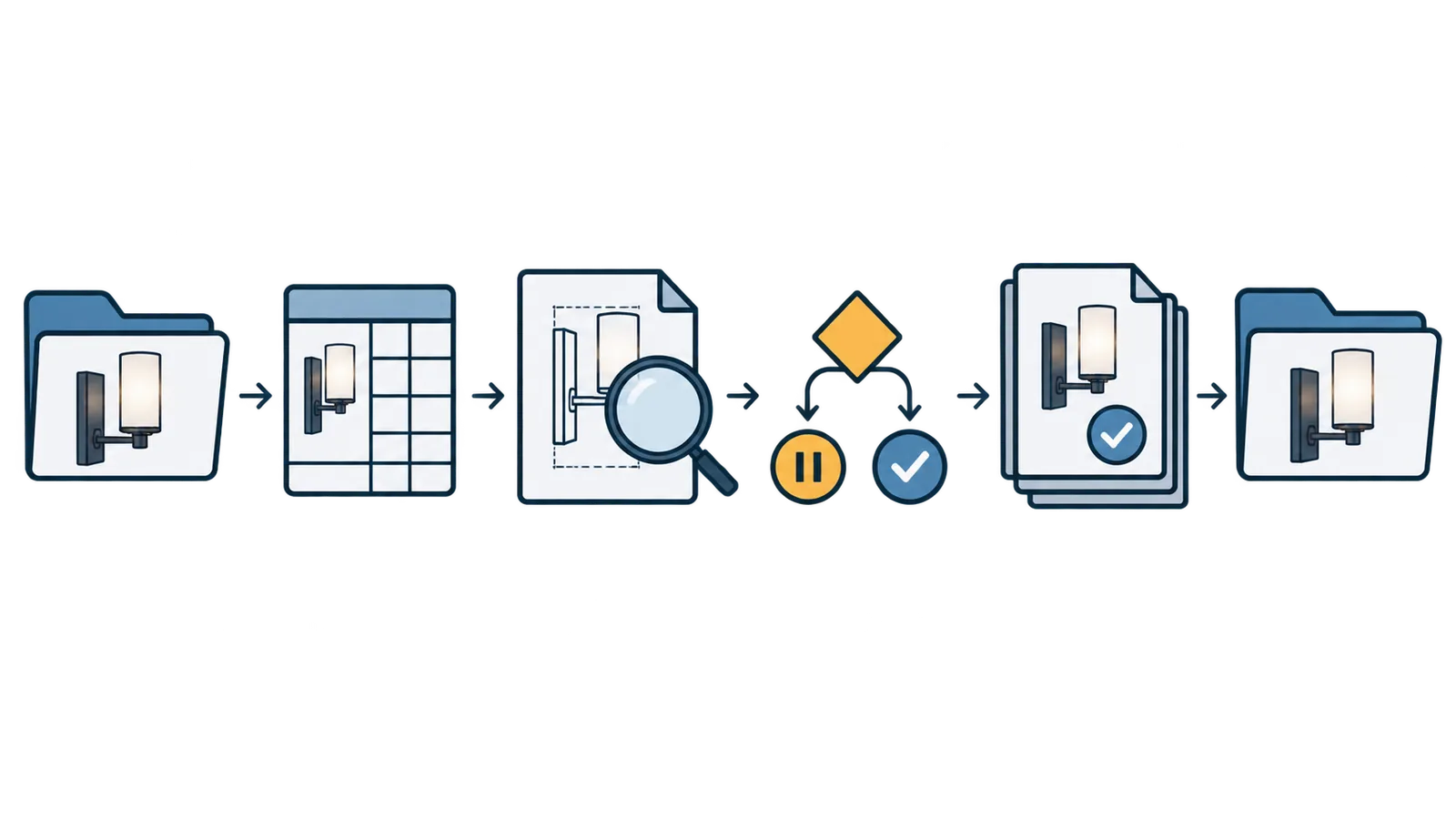
- Buyer input: fixture schedule, candidate model, destination, quantities, location/use context, and required documents enter the register.
- Supplier document register: each available file is logged by filename, issue date, model/configuration coverage, and source.
- Technical/design review: the designated reviewer compares document coverage with the candidate configuration and project requirement.
- Disposition: mark each item accepted, accepted with documented exception, revise/resubmit, not supplied, or not applicable.
- Approval record: store reviewer, date, approval reference, and exception impact where one exists.
- Release or hold: issue a quote/submittal only under the recorded go/no-go rule; archive superseded files rather than leaving them in circulation.
This is a document-control workflow, not a promise that every project or supplier uses the same approval authority.
Request model-level documents and check the match
Drawings and installation records
Request the current dimensioned drawing and installation instruction for the candidate configuration. Check model/version, drawing revision, dimensions and projection, mounting interface, and stated installation conditions. A drawing alone does not establish that a field substrate, wiring method, or project condition is suitable; those questions belong to responsible project parties.
For early site coordination, the electrical rough-in planning guide for wall sconces may help identify planning questions. It does not replace the installation document for the selected fixture.
Photometric files, when the project requires them
Request photometric information when the project specification, lighting design, or proposed claim requires it. Match the candidate model and configuration to the report or data file before relying on it. Record the fixture/model identifier, light-source or driver configuration where relevant, report date, stated measurement method, and related distribution/data-file identity. Do not transfer an LM-79 report or an IES file from a similar-looking model to the candidate fixture.
ANSI/IES LM-79-24 is an approved method for optical and electrical measurements of solid-state lighting products, not a certification or project approval. See the official LM-79-24 page.
Finish, maintenance, packaging, and replacement identity
For finish, retain the approved reference, source, date, and configuration it covers. For maintenance or replacement, record model/version, drawing revision, finish reference, approved sample reference if used, and carton/SKU identity. Ask what documentation is available; do not present replaceable components, spare-part availability, or long-term continuity as fact without approved evidence.
For packaging, record the package configuration and label identity. If distribution testing is a project requirement, select a procedure that fits the actual package and route. ISTA describes 1-Series non-simulation integrity tests, 2-Series partial-simulation tests, and 3-Series general-simulation tests; the selected procedure and tested configuration should be recorded rather than inferred from a carton image. ISTA test procedures
Commercial wall-sconce submittal register
Use this as a copyable blank template. It is a record format, not evidence that a model or document exists.
| Fixture tag/project area | Candidate model/version | Required-by date | Document filename and revision | Model/configuration match | Responsible party | Review disposition | Exception/impact | Approval reference/date | Superseded by | Closure evidence |
|---|---|---|---|---|---|---|---|---|---|---|
| Match / mismatch / not established | Accepted / Accepted with exception / Revise-resubmit / Not supplied / N/A | |||||||||
| Match / mismatch / not established | Accepted / Accepted with exception / Revise-resubmit / Not supplied / N/A |
Use the quote gate instead of a generic disclaimer
| Required condition | Decision rule | Quote status | Closure action |
|---|---|---|---|
| Fixture identity, candidate configuration, and current drawing are not established | Do not assume a photo or similar SKU identifies the product | Hold | Obtain the controlled model/version and drawing reference |
| Installation information is required for the stated project condition but is not available | A dimension alone does not close installation questions | Hold or issue only under buyer-approved documented exception | Obtain installation record or record accepted exception and owner |
| Buyer-required compliance or location document is missing | No category-level claim can replace model-specific evidence | Hold | Define requirement, confirm model coverage, and retain applicable evidence |
| Photometric file is required but cannot be matched to model/configuration | Similarity is not a match | Hold | Obtain a traceable report/data-file match or revise candidate |
| Finish, packaging, or replacement information is missing | Whether it blocks release depends on stated project requirement | Hold or proceed only with documented exception | Name impact, approver, due date, and closure record |
Red flag for emergency/egress language: for workplace exit routes, OSHA requires adequate lighting so an employee with normal vision can see along the route under 29 CFR 1910.37(b)(1). This is not evidence that any wall sconce meets all building, fire, emergency-lighting, or local-code requirements. Keep any related product claim tied to the selected model and responsible project review.
Likewise, an IP statement remains model-specific. IEC 60529 covers degrees of protection provided by enclosures; it should not be used as evidence of UV, salt-spray, coastal, high-temperature, or long-term durability performance. UL Product iQ is a route to check UL certification information, not proof of certification for an unverified candidate.
Control revisions and replacement records before award
Treat a change to model/version, drawing, finish, mounting, driver/light-source configuration, labels, packaging, or claim set as a revision trigger. The record should identify the change, affected fixture tags, document owner, reviewer, approval reference, and superseded file. Release only the current approved record; archive the older copy with a visible “superseded by” reference.
Replacement planning begins at this stage because a later request for “the same wall sconce” is not enough to identify a configuration. Preserve fixture tag, model/version, drawing revision, finish reference, approval record, and carton/SKU identity. This establishes identification continuity without promising product availability or replacement service.
Next step: request available documents and a documented gap status
To build a register, submit the fixture schedule or drawing, candidate model/version, destination, quantity by phase, installation context, finish reference, and documents required by the project. Request the available model documents and a documented gap status: available, not supplied, not applicable, or requiring revision. This request does not promise a review outcome or supplier capability. To browse wall-sconce products or submit inputs, use the project document inquiry form.
FAQ
What is the difference between a fixture schedule, product data sheet, and lighting submittal?
A fixture schedule identifies what the project intends to use and where. A product data sheet describes a product or configuration. A submittal package is the controlled collection of project-relevant documents and review status tied to the fixture schedule. The exact contract process may differ by project.
Can a commercial wall sconce be quoted before every submittal document is approved?
That is a commercial and project decision. Use the quote gate: hold where identity, required installation information, buyer-required compliance evidence, or required photometric match is missing. Other gaps may proceed only when impact, responsible approver, due date, and closure action are documented.
Which claims should remain model-specific in a commercial quote?
Dimensions, projection, mounting, optical data, certifications, IP or location ratings, emergency function, materials, finish durability, compatibility, and replacement/service statements should be tied to current evidence matching the candidate configuration.
Why track drawing revisions and finish references before award?
They establish exactly what was reviewed and approved. The same identifiers also make later maintenance, replacement identification, and exception resolution more reliable.

SconceHaus
The SconceHaus team shares practical wall-light sourcing, specification and project insights for professional buyers.
Wall Lights for Your Next Project
Compare specifications and add suitable models to one consolidated quote request.

Related Lighting Insights
Sep 20, 2026
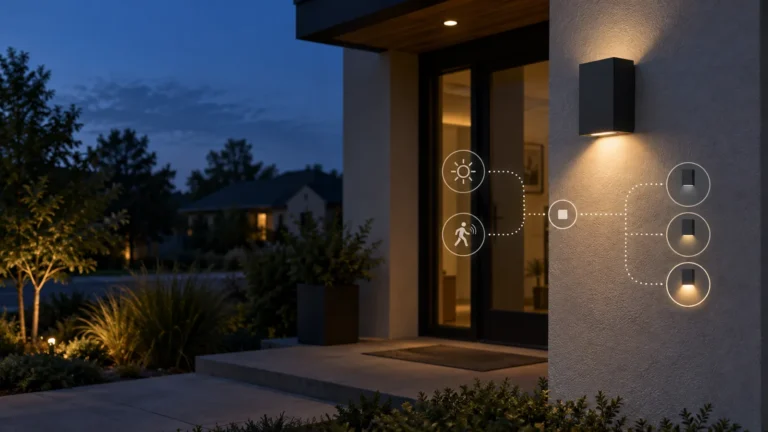
Outdoor Motion Sensor Wall Lights: A Buyer’s Guide to Control Modes and Channel Positioning
Use a mode evidence sheet to compare outdoor motion sensor wall-light control logic, approve channel claims, and close…
Sep 15, 2026
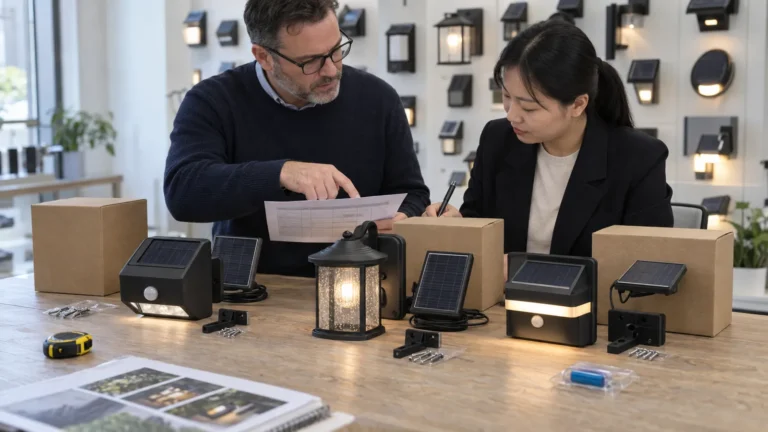
Solar Outdoor Wall Lights Range Guide for Distributors
Distributors building a solar outdoor wall lights range should start with the sales channel and use case, then…

Sep 3, 2026
The Complete Guide to Choosing Wall Sconces & Planning the Electrical Rough-In
Learn how to choose wall sconces and plan electrical rough-in details, including CRI, color temperature, glare control, junction…
Working With SconceHaus
Common questions about samples, customization, quality, production and delivery.
Why should I choose you over other suppliers?
We are a professional manufacturer and supplier located in Zhongshan, China, specializing in the development, design, production, sales, and after-sales service of home furnishing lamps.
How do you ensure the quality of your products?
We always provide a pre-production sample for your approval before mass production and conduct a final inspection before shipment.
What are your terms of payment and delivery?
We accept various delivery terms (FOB, EXW, etc.), payment currencies (USD, EUR, CNY), and payment methods (T/T, L/C). Our team is fluent in English and Chinese.
Can I get a sample before placing a bulk order?
Yes, we welcome sample orders for you to test and check quality. Mixed samples are acceptable.
How long does it take to produce and deliver?
Sample production takes 3-5 days. For mass production, the lead time is 1-2 weeks, depending on the order quantity.
What are my shipping options and how long will they take?
We ship by DHL, UPS, FedEx, or TNT (3-5 days), and also offer air and sea freight options.
What is the ordering process step by step?
1. You tell us your requirements or application.
2. We provide a quote based on your needs.
3. You confirm the sample and place a deposit.
4. We start production.
What are the dimensions of wall sconce?
While standard dimensions are available, please contact us for custom sizes. Our wall sconce is a fixed-mount structure, ideal for bedrooms, vanity areas, and boutique hotel suites.
Are your wall lights suitable for the U.S. market?
We can provide wall-light solutions designed for U.S. voltage and project requirements. Certification availability varies by model, so please confirm UL or ETL requirements with our team before ordering.
Discuss Your Wall Lighting Project
Tell us what you are sourcing, the estimated quantity and your project requirements. We normally reply within 24 hours.