Outdoor Motion Sensor Wall Lights: A Buyer’s Guide to Control Modes and Channel Positioning
Table of Contents
- Why control logic changes an outdoor wall-light assortment
- Feature label versus documented operating condition
- Use a mode decision sequence before writing channel copy
- The control modes a buyer should distinguish
- Build a one-page mode evidence sheet
- Position the SKU by customer expectation and return risk
- Close version conflicts before release
- Next step: assemble the mode-evidence decision pack
- FAQ
- What documentation should a distributor request for a motion sensor wall light?
- What is the difference between a motion sensor and a photocell on an outdoor wall light?
- Can dusk-to-dawn and motion operation be described as the same feature?
- What causes false triggers in a motion sensor wall light?
Outdoor motion sensor wall lights should be selected by documented control logic, not by appearance or a short feature label. Before a distributor, retail buyer, importer, or private-label team approves a SKU, the useful output is a one-page mode evidence sheet, an approved claim set, and a go/no-go decision. These records align packaging, instructions, and listing copy and make it possible to separate a mode misunderstanding from a functional deviation.
This guide is for channel buyers preparing a candidate SKU for listing or approval. It shows how to move from supplier material to a documented decision without assuming that any SconceHaus model has a particular sensor, mode, rating, or test result. It does not compare panel, battery, lumen, IP, or sample-test specifications; those are separate procurement tasks.
Why control logic changes an outdoor wall-light assortment
“Motion sensor” does not say whether a light is normally off, whether daylight suppresses activation, how long activation lasts, what happens after the delay, or whether manual control changes the sequence. Those differences affect customer expectation, product-page wording, instructions, and return handling.
Lighting-control guidance distinguishes inputs such as light sensors and occupancy sensors from the controller and output device. A photocell measures available light and can send a control signal; an occupancy sensor responds to detected presence or movement. A channel description should not combine these distinct inputs into one vague feature label. See the U.S. Department of Energy’s exterior lighting-control guidance.
Feature label versus documented operating condition
A feature label may say “motion activated.” A documented operating condition identifies the selected mode, ambient-light condition, default state, trigger, delay, return state, manual override, and source-document revision. Only the second is a usable basis for a claim decision.
When a customer reports a “sensor problem,” classify the issue before assigning a remedy: mode-selection misunderstanding, installation-context mismatch, instruction gap, packaging/listing mismatch, or observed functional deviation. One generic defect label does not reveal whether corrective action belongs in copy, documentation, installation guidance, or product investigation.
Use a mode decision sequence before writing channel copy
Start with the documented mode, not the phrase a marketplace team hopes to use.
- Confirm the exact model/version and the relevant power/control context.
- Confirm the documented default state: off, low output, or another stated state.
- Confirm the trigger: movement, ambient light, both, or a manual action.
- Confirm hold and return behavior, including any stated retrigger logic.
- Record any stated manual override, reset, or low-power behavior rather than inferring it.
- Compare the current evidence with proposed copy. Approve supported wording; put unsupported wording on hold.
The result is not a universal performance promise. It is a decision record showing why a buyer chose a description, which document supported it, and what still needs closure.
The control modes a buyer should distinguish
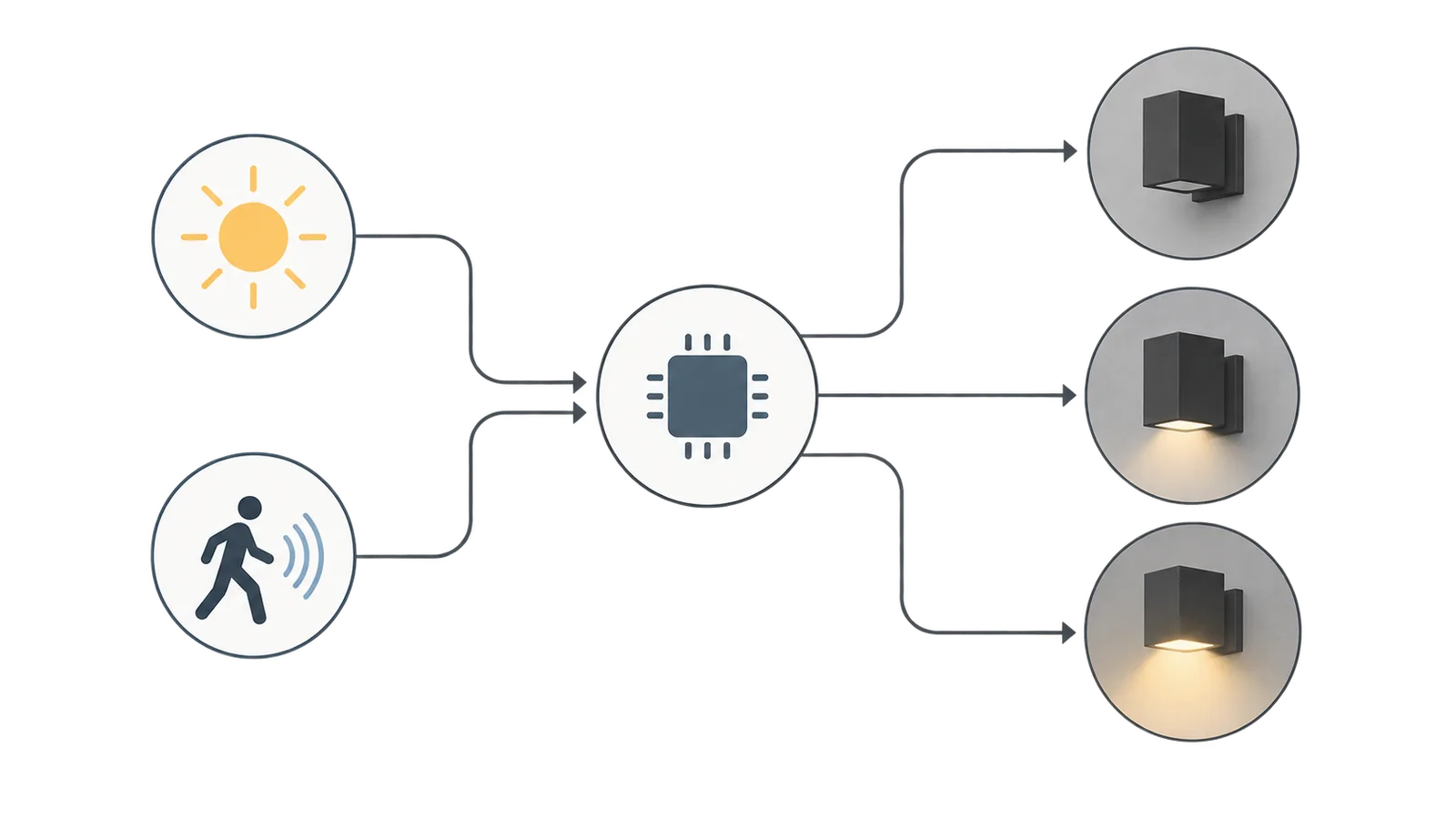
The following are generic patterns. A model manual and current mode table must establish whether any candidate product uses one of them.
| Generic pattern | Buyer decision | Minimum document needed | Common listing risk | Decision outcome |
|---|---|---|---|---|
| Motion-only | Is the stated trigger and return sequence clear for the intended use? | Current mode table or manual showing default state, trigger, delay, and return state | Describing all movement or all conditions as covered | Approve only the documented sequence; otherwise hold copy |
| Photocell/dusk-to-dawn | Does the light sensor control on/off, or only prevent daytime motion activation? | Manual or flow diagram stating the photocell’s role and mode dependency | Treating dusk-to-dawn as identical to motion operation | Use separate wording for each documented input |
| Low-output plus motion boost | Are standby level, boost trigger, boost duration, and return state stated? | Current flow diagram or mode table for the selected configuration | Calling the product “all-night” or “security” without supporting conditions | Approve only the stated transition; otherwise request clarification |
For a named detection distance, angle, delay, or coverage statement, retain the actual test condition and source document with the claim. A generic demonstration or a visually similar SKU is not evidence for the selected configuration.
Build a one-page mode evidence sheet
Use this copyable template as a controlled decision record. Leave a field blank until its source is received; a blank field means no public claim is approved for that item.
| Candidate model/version | Intended channel and use | Document filename/revision | Default state | Trigger and stated condition | Hold/return behavior | Manual or exception behavior | Proposed claim | Evidence owner | Buyer reviewer | Decision | Decision date | Open deviation and closure evidence |
|---|---|---|---|---|---|---|---|---|---|---|---|---|
| Pass / Conditional / Hold / Reject | ||||||||||||
| Pass / Conditional / Hold / Reject |
Illustrative use only: If a current mode table identifies a low state, a motion-triggered boost, and a documented return state, an approved claim set can state that sequence. It should not add a fixed range, an all-night duration, or security coverage unless the matching document provides those facts and conditions. If packaging says “dusk-to-dawn” but the document does not confirm that role for the configuration, place the wording on hold.
Position the SKU by customer expectation and return risk
| Intended assortment question | Customer expectation to test | Failure or return risk | Minimum evidence before release | Go/no-go rule |
|---|---|---|---|---|
| Security-oriented offering | What event is stated to cause activation, and in what context? | A feature label is interpreted as guaranteed coverage | Model-specific mode document and stated test conditions for any numerical claim | No claim release if condition or configuration is unclear |
| Entryway offering | Can a user understand daylight behavior, delay, and manual control? | Activation differs from purchaser expectation | Current manual and installation instruction matched to model/version | Hold listing until instructions and copy agree |
| Pathway offering | What is the stated default and return state? | Continuous-use expectation is created without support | Mode table plus operating conditions relevant to proposed wording | Use only the documented state transition |
| Decorative outdoor offering | Does presentation imply a control function? | Appearance creates a functional inference | Approved image and claim set reviewed against current documents | Remove implied claims lacking evidence |
For wider assortment planning, see the solar wall-light range guide for distributors. It addresses range/SKU planning rather than this article’s claim-approval workflow.
Close version conflicts before release
When a carton, manual, product page, sample observation, or artwork uses different control wording, do not average the statements.
- Hold the affected packaging and listing claim.
- Assign an evidence owner and name the exact files in conflict.
- Compare document revision, model coverage, and configuration.
- Record the decision: pass, conditional approval with a stated limitation, hold, or reject.
- Approve one claim set with reviewer and date; archive superseded copy with its revision reference.
- Release the approved claim set to packaging, marketplace, sales, and service owners.
An IP, wet-location, UL, or other listing/certification statement is a separate model-specific review. IEC 60529 concerns degrees of protection provided by enclosures; it is not evidence of corrosion, UV, coastal, or service-life performance. UL Product iQ is a route for checking UL certification information, not evidence that a particular model is certified.
Next step: assemble the mode-evidence decision pack
Submit the candidate model/version, intended channel, destination market, intended installation context, current manual or mode table, and proposed customer-facing claim. The buyer can then record document availability, claim match, decision status, and the evidence needed to close any gap. For product browsing, see Solar Wall Lights; to submit the decision-pack inputs, use the product inquiry form.
FAQ
What documentation should a distributor request for a motion sensor wall light?
Request a current model manual, installation instruction, mode table or flow diagram, stated test conditions for numerical claims, and approved packaging/listing copy. Keep each item with model coverage and revision.
What is the difference between a motion sensor and a photocell on an outdoor wall light?
A motion/occupancy sensor responds to detected movement or presence. A photocell/light sensor responds to ambient light. A model may use either or both, but the actual control sequence must come from model-specific documentation.
Can dusk-to-dawn and motion operation be described as the same feature?
No. They are different control inputs or patterns. A combination may exist for a configuration, but approved copy should describe only the sequence supported by that configuration’s documents.
What causes false triggers in a motion sensor wall light?
Possible causes depend on sensor type, mounting context, approach path, ambient conditions, selected mode, and stated test setup. Record the observed condition and compare it with the documented operating condition before deciding whether the issue is installation-related, documentation-related, or a functional deviation.

SconceHaus
The SconceHaus team shares practical wall-light sourcing, specification and project insights for professional buyers.
Wall Lights for Your Next Project
Compare specifications and add suitable models to one consolidated quote request.
Related Lighting Insights
Sep 23, 2026
Commercial Wall Sconce Submittal Checklist for Project Buyers
Use a commercial wall sconce submittal checklist to control drawings, document gaps, approvals, revisions, and quote go/no-go decisions.
Sep 15, 2026
Solar Outdoor Wall Lights Range Guide for Distributors
Distributors building a solar outdoor wall lights range should start with the sales channel and use case, then…
Sep 3, 2026
The Complete Guide to Choosing Wall Sconces & Planning the Electrical Rough-In
Learn how to choose wall sconces and plan electrical rough-in details, including CRI, color temperature, glare control, junction…
Working With SconceHaus
Common questions about samples, customization, quality, production and delivery.
Why should I choose you over other suppliers?
We are a professional manufacturer and supplier located in Zhongshan, China, specializing in the development, design, production, sales, and after-sales service of home furnishing lamps.
How do you ensure the quality of your products?
We always provide a pre-production sample for your approval before mass production and conduct a final inspection before shipment.
What are your terms of payment and delivery?
We accept various delivery terms (FOB, EXW, etc.), payment currencies (USD, EUR, CNY), and payment methods (T/T, L/C). Our team is fluent in English and Chinese.
Can I get a sample before placing a bulk order?
Yes, we welcome sample orders for you to test and check quality. Mixed samples are acceptable.
How long does it take to produce and deliver?
Sample production takes 3-5 days. For mass production, the lead time is 1-2 weeks, depending on the order quantity.
What are my shipping options and how long will they take?
We ship by DHL, UPS, FedEx, or TNT (3-5 days), and also offer air and sea freight options.
What is the ordering process step by step?
1. You tell us your requirements or application.
2. We provide a quote based on your needs.
3. You confirm the sample and place a deposit.
4. We start production.
What are the dimensions of wall sconce?
While standard dimensions are available, please contact us for custom sizes. Our wall sconce is a fixed-mount structure, ideal for bedrooms, vanity areas, and boutique hotel suites.
Are your wall lights suitable for the U.S. market?
We can provide wall-light solutions designed for U.S. voltage and project requirements. Certification availability varies by model, so please confirm UL or ETL requirements with our team before ordering.
Discuss Your Wall Lighting Project
Tell us what you are sourcing, the estimated quantity and your project requirements. We normally reply within 24 hours.